Inside: Spanish listening activities for Spanish class at every level. Easy listening activities for Spanish class with songs, videos, stories, dictations & podcasts, Spanish listening activities for beginners, & Spanish listening practice ideas for Spanish 1, 2, 3 & 4 that build interpretive listening without a textbook CD.
Author – Allison Wienhold
Why Listening Can Be A Skipped Skill
If you ask Spanish teachers which skill their students struggle with most, authentic listening comes up a LOT. Part of the reason is that we don’t always practice it on purpose. Teacher talk in Spanish (hopefully). But “listen to me give directions” is not the same as planned authentic listening practice. Plus, the accent of the same teacher is not the same as the diversity of the Spanish speaking world.
Plus, some are stuck with the idea that listening practice has to be a boring pre recorded textbook script that you pause. (The OGs like me remember these listening activities on CDs or even cassettes 🙂 The newer version students accept begrudgingly are the textbook website listening practice activities. Sure, they work great as a sub plan, but regularly it becomes repetitive.
The good news is that listening can also the easiest skill to sneak into every single class. Students hear Spanish in songs, videos, stories, films & from each other. The trick is giving them a reason to listen & a quick way to show you what they understood.
So here are the Spanish listening activities I come back to again & again. They are organized from low-prep warm-ups to bigger lessons.
Before You Start: Make Listening Comprehensible
A quick note before the list. Students don’t learn much from listening to something they understand 10% of. That just feels like noise & they check out. So for any listening activity:
- Front Load Key Words – practice & write 3-5 key words on the board before they listen
- Give a specific job – “Listen for the colors” is much better than “Listen & tell me what it says.”
- Listen more than once – each time can have a specific task. For example first for the big idea, then two more times for details.
- Let them show it without writing a paragraph – it’s ok to check for comprehension in many ways – thumbs up, a drawing, moving to a corner, answer a question in writing in English or a quick check on a whiteboard. *If you are asking students to answer a written question in Spanish about a video in Spanish, you are including reading comprehension, as well as presentational writing. It’s hard to differentiate if students truly do not understand the listening with others in the mix.
Making listening practice in Spanish can be the difference between “listening practice” & students staring out the window.
Spanish Listening Activities with Music
If you are long time reader, you should know I’m going to start with Music. In my experience a song is the easiest way to get students listening, because they actually want to. It’s typically a big part of almost every class I teach. If you are new to it, start with my post on what to do with a song in Spanish class.
1. Música miércoles
Every Wednesday, we listen to a new song in Spanish, talk about the artist & nationality & answer a couple of questions. It takes about 5-10 minutes & it is many students’ favorite part of the week. The repetition of the routine is what makes it work. Students know exactly what to listen for each week. They have a specific, easy task while listening. The main goal is enjoying the music.
Want 25 editable Google Slides of current & authentic songs in Spanish with a diverse mix of artists & styles? Each slide has the title, artist, nationality, video & 2 questions in Spanish & can be differentiated for Spanish 1 through Spanish 4
>> Or Middle School Música miércoles
>> Teach French? NEW French Class Music Slides
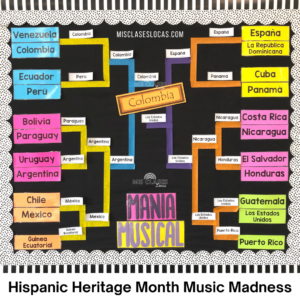
Also, I love doing seasonal Music Brackets as well.
For these, we typically listen to two songs per day until the bracket is done.
>> mania musical – March Music Madness
>> Hispanic Heritage Month Music Bracket
Want a sample of all of my music activities? Enter your email below.
Want to mix it up beyond my ready to go slides? See more music ideas below.
2. Lyric cloze
The classic cloze fill in the blank. Give students the lyrics with some words missing. They fill them in as they listen. For beginners, give a word bank. For upper levels, take out verbs in the tense you are working on. But, like any task it gets boring if students have to listen for blanks with every song.
A twist to mix it up for super novice students is a word cloud of the words. Students race to highlight the words as they hear them in the song or video.
3. Wrong lyrics
For more advanced students you can give students the lyrics, but change a few words. They listen & circle the words that are wrong. This forces close listening without the stress of writing from scratch, & then students catch the “mistakes.”
4. Order the Lyrics
Cut the lyrics into strips. In pairs, students put them in order while the song plays. It gets loud & a little competitive, which is the point. For novice students cut into major chunks like the whole chorus & verses to make it more manageable. You can do the same activity with ordering chunks of dialogue in a video.
Spanish Listening Activities for Beginners
These Spanish Listening Comprehension Activities work especially well with Spanish 1 & middle school, but upper levels still enjoy them.
5. Four corners
Read a statement or question with four answer choices. Students walk to the corner that matches their answer. It is listening + movement + instant feedback for you. I explain my twist on it in 4 Corners for Spanish class. Or with just two options, you can do a move to each side.
6. Draw what you hear
Describe a person, a room, or a silly scene & students draw it. Hay un gato grande. El gato tiene un sombrero azul. Compare drawings at the end. It is a great check for vocabulary like colors, clothes, & prepositions.
7. Sí o no / Cierto o falso
Make statements about a picture on the screen & students show thumbs up or thumbs down, or hold up a cierto/falso card. Super simple, but every single student has to process the Spanish. Or for more movement stand up if true or move to each side if true.
BONUS! Mix up true false even more with with 2 movement games 1, 2, 3, ¡SALTA! game to get class moving or The Marker Game
8. Picture talk & Movie Talk
Describe an image or a short video in simple Spanish, asking lots of questions as you go. Students hear the same structures many times in a context that keeps them interested. For best results front load the vocab by using screen shots of the shirt film in advance to avoid having to pause a ton.
Here is how I run a full Movie Talk in Spanish class. See Top 7 Short Spanish Movies on Disney+ for ideas.
Spanish Listening Activities with Videos
9. Travel videos
Short travel videos are perfect listening practice, & they bring culture in at the same time. An ideas is Tuesday (or any day you prefer) students do martes del mapa, where they “travel” to a different Spanish-speaking country. These slides have a map & a short video. Learn more in travel videos in Spanish class.
Or you can use my slides to do a mini unit Teaching Spanish Speaking Countries over a few days.
My Martes del mapa slides each have a map, the country & capital, a short travel video, & a question, so the routine is ready for the whole year.
10. Señor Wooly
If you have not used Señor Wooly’s songs & stories, they are a fun break for novice Spanish class. Students (& teachers) really do get the comprehensible songs stuck in their heads. See how I have used it in Señor Wooly in Spanish class.
11. Movies & TV Series
A movie in Spanish can be great listening practice, as long as students have something to do while they watch. Pause for quick predictions, have them listen for specific phrases, or use a guide so they stay focused. Turn on Spanish subtitles for upper levels for a reading & listening combo.
If you want guides ready to go, the Spanish Movie Guides Bundle has 20 editable movie guides with questions in both Spanish & English, so you can use them with every level. They also make really easy sub plans.
I love using TV series weekly in upper level Spanish as well. Learn more in Teaching TV Shows in Spanish Class
Plus encourage students to watch TV shows outside of school as well. For ideas to suggest Top 10 Appropriate Netflix Shows in Spanish Class & Top Spanish TV Series on Disney+ for Class.
Spanish Listening Exercises with Dictation
While not always communicative, a dictation very once and a while can be a great way to check and figure out the little transition words.
12. Running dictation
This is listening, speaking, reading & writing all at once. One partner runs to read a sentence posted in the hall, comes back, & tells it to their partner, who writes it down. It gets loud, it gets competitive, & it works. Here is my full running dictation post.
13. Classic dictado
Read 4-5 sentences from a story you just read in class. Students write what they hear, then self-correct by comparing to the original. Short & low-stakes, it is a great way to practice the connection between sounds & spelling.
Spanish Listening Practice for Upper Levels & Homework
14. Podcasts in Spanish
For upper levels or choice homework, podcasts are a great way to get more listening outside of class. A few I would point students to.
- ¡Cuéntame! | Learn Spanish with Comprehensible Input – Marta Ruiz Yedinak, a Spanish National Board Certified Teacher, uses basic to intermediate level Spanish to tell stories and talk about everyday topics.
- Dreaming Spanish – comprehensible input videos sorted by level, with a big free library, including videos for absolute beginners.
- Duolingo Spanish Podcast – true stories told in easy Spanish with English narration. The show stopped making new episodes in 2024, but the archive is still free with transcripts.
- Radio Ambulante – NPR’s Spanish-language storytelling podcast about Latin America. It is native speed & advanced, so save it for Spanish 4, AP, or heritage speakers.
As always please check preview any podcast episode to see if fits your students before you assign it.
15. Partner listening
Don’t forget that students listening to EACH OTHER counts too. During any partner conversation, give the listener a job: write down two things their partner said, or report back one thing to the class. Suddenly the listener is not just waiting for their turn to talk.
Or better yet connect with heritage and native speakers to come in and chat in your classes. Also, encourage students to use their Spanish outside of class with conversation groups, and connecting with Spanish speakers.
How to Check Listening Without a Big Test
You don’t need a formal listening quiz to know if students understood. Here are quick checks you can pick from.
EXIT SLIP – One sentence in English or Spanish: “The most important thing the speaker said was…” Novices can answer in English. You are checking listening, not writing.
3-2-1 – 3 words they heard, 2 things they understood, 1 question they still have. Works for any song, video, or story.
QUICK DRAW – Students sketch the main idea in 60 seconds. You can see who got it from across the room. You can do this on whiteboards if you have a class set.
WHITEBOARD CHECK – After each section, ask one question & everyone holds up an answer at the same time. No hiding.
RETELL IN PAIRS – Partner A retells what they heard in 30 seconds, Partner B adds one detail A missed. Then switch.
When you do want a grade, use the same kind of task students have been practicing in class. If they always listen to songs & answer questions, an interpretive assessment with a new song will feel familiar instead of scary. And grade what they understood, not their spelling.
How Often Should You Do Listening Activities?
Every day, in small doses. I would rather have students do 5-10 minutes of focused listening in every class than just one big listening test at the end of a unit. Routines like música miércoles & martes del mapa make that happen without extra planning, because the listening is already always built into the week.
What Are Your Favorite Spanish Listening Activities?
What listening activities work best in your Spanish classes? Is there one your students ask for? Let me know!