Inside: Las Posadas activities for Spanish class. How to teach Las Posadas in middle school & high school Spanish with videos, the pidiendo posada song, vocabulary, a piñata project, cultural comparisons & low-prep ideas by level. Las Posadas facts, traditions, food, and Las Posadas 2026 dates, plus how to keep it respectful in a public school.
Author – Allison Wienhold
Posted – November 23, 2026
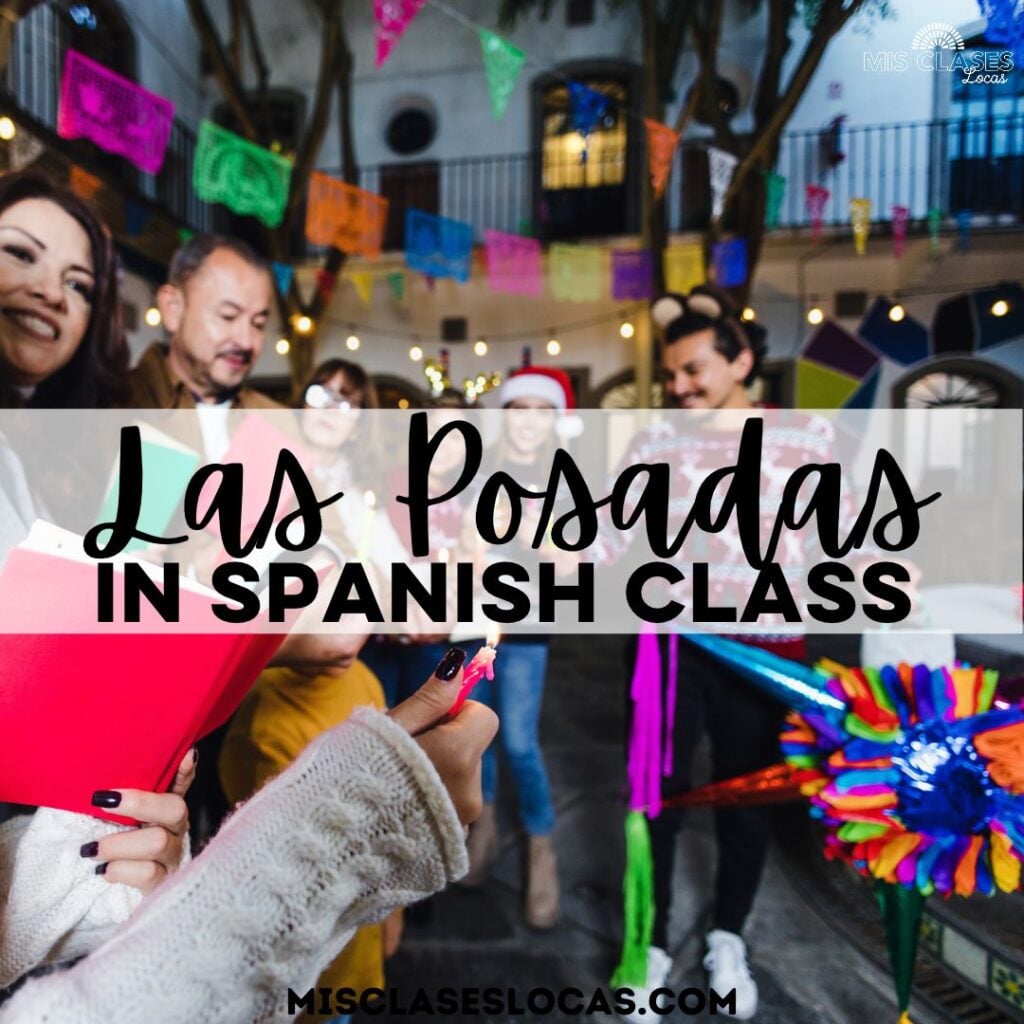
December in Spanish class is always a balancing act. Students are tired, the schedule is full of disruptions and you still want class to feel like Spanish class.
My first teaching job was at a Catholic School. They always encouraged to tie in faith as much as possible. If you happen to teach at a Christian School, I suggest you check out Las Posadas.
Las Posadas is another great way to bring real culture into those last weeks before winter break. It is about community, music, food & neighbors, not just presents.
It also lines up perfectly with the calendar. Las Posadas runs December 16–24, which is usually right when we are squeezing in the last week (or two) before break.
So in this post I will share what Las Posadas is, the traditions your students will want to know about, videos that work in class, and Las Posadas activities by level. If you want my bigger overview of December, start with Winter Holidays in Spanish Class. This post goes deep on just Las Posadas.
What Is Las Posadas?
Las Posadas is a Christmas tradition celebrated mostly in Mexico, and also in Guatemala, other parts of Central America, and many Mexican-American communities in the US. For nine nights, from December 16 to December 24, friends & neighbors walk from house to house reenacting Mary and Joseph’s search for a place to stay in Bethlehem.
Posada means inn or lodging, so pedir posada means to ask for shelter. Each night the group (los peregrinos, the pilgrims) sings at the door asking for posada. The people inside (los posaderos, the innkeepers) sing back and turn them away, until the last house finally lets everyone in. Then the party starts.
Las Posadas Facts for Students
These are the quick facts I would put on a slide or use for a true/false warm-up.
- When: 9 nights, December 16–24. In 2026 that is Wednesday, December 16 through Thursday, December 24 (Nochebuena).
- Why 9 nights: The nine nights are traditionally said to represent the nine months of Mary’s pregnancy.
- Where: Mostly Mexico, plus Guatemala, parts of Central America & the US Southwest. Cities like San Antonio & Santa Fe host big public posadas.
- Who: Families, neighbors, churches, schools & even workplaces. In Mexico today, a “posada” can also just mean a December holiday party.
- Origins: Historians usually trace Las Posadas to colonial Mexico in the late 1500s. It is often connected to the monastery of San Agustín Acolman, near Mexico City, where friars held special December masses in 1587. Many sources also point out it blended with Indigenous celebrations that already happened in December.
- What happens: A procession with candles & faroles (lanterns), a call-and-response song at the door, and then food, ponche, aguinaldos & a piñata.
Las Posadas Traditions
When I teach a culture lesson, I want students to walk away with a few concrete images. With Las Posadas, these are the ones that stick.
La procesión
The group walks together carrying velas (candles) or faroles. Sometimes children dress up as María, José, angels & shepherds, or the group carries small figures of María & José. In some neighborhoods it is very formal, and in others it is a big, noisy walk down the street with everyone singing. (If you teach younger students, this can be fun to act out together).
Pidiendo posada (the song)
This is the heart of the tradition. The group outside sings verses asking for shelter, and the group inside sings verses refusing, back and forth. It opens with:
En el nombre del cielo, os pido posada, pues no puede andar mi esposa amada.
And the people inside answer:
Aquí no es mesón, sigan adelante. Yo no puedo abrir, no sea algún tunante.
At the end, the doors open and everyone sings Entren, santos peregrinos… Students love that it is basically a musical conversation. I go into how to use it below.
La comida
After the door opens, there is food! Common favorites during Las Posadas are:
- Ponche navideño – a warm fruit punch with guava, tejocotes, sugarcane, apple & cinnamon
- Tamales
- Buñuelos – crispy fried dough with sugar or syrup
- Atole or champurrado – thick warm corn drinks (champurrado has chocolate)
But, like any tradtion, each family may have their own version, food & traditions.
Los aguinaldos
Aguinaldos are little bags of treats handed out at posadas, usually with candy, peanuts, fruit like oranges or tangerines, and sometimes small toys. This is a fun one for students because it is so different from a goody bag at a US party.
La piñata
The traditional posada piñata is a star with seven points. A common explanation is that the seven points represent the seven deadly sins, and breaking the piñata represents defeating them, with the treats inside as the reward. Everyone sings Dale, dale, dale, no pierdas el tino… while someone swings.
If you want to go deeper with piñatas, I have a whole piñata mini-unit post with authentic videos & ideas.
I also have a newer full piñata unit that makes a perfect December project!
Las Posadas Videos for Spanish Class
Please preview every video before class, especially for your school community. These are options at a few different levels.
Conoce la tradición de las Posadas Navideñas (in Spanish)
A short Spanish video made for young learners. Since it is made for little kids, it works well as a movie talk with Spanish 1 if you pause and ask simple questions.
La Posada: A Mexican Tradition (bilingual)
For upper levels, this bilingual video (Spanish & English) looks at the posada as a tradition of faith and community. It is a nice lead-in to a cultural comparison discussion.
Las Posadas Explained (in English)
If you teach exploratory or a middle school wheel class, this English cartoon explainer gives the background quickly so you can spend the rest of class on the song or the piñata.
Canción para pedir posada (with lyrics)
A lyrics video of the traditional song. Use it after students know the story so they can follow the back-and-forth.
Dale, dale, dale (piñata song)
The piñata song is short and super repetitive, so even Spanish 1 can sing along by the second time through.
Las Posadas Activities for Spanish Class
Here are the Las Posadas activities I would pick from, depending on how much time you have. You do not need all of them. One or two days is plenty for most classes.
1. Start with a Para Empezar bell ringer
I like to introduce a holiday with a slide on the board as students walk in: a picture, a short video, and two or three questions in Spanish. ¿Qué ves? ¿Dónde es? ¿Qué celebran? It builds curiosity without a big lesson.
My Spanish Christmas bell ringers are set up exactly like that for December and January, with cultural slides you can edit. If you have never used daily warm-ups this way, here is how I run them in Bell Ringers for Spanish Class.
2. Vocabulary first, then video
Before a video, I give students 8–10 words max. Depending on which video, pick what is important & new to your class. Here are some common words you might want to intro with Las Posadas:
| Español | English |
|---|---|
| la posada | lodging, inn (and the celebration) |
| pedir posada | to ask for shelter |
| los peregrinos | pilgrims (the group outside) |
| los posaderos | innkeepers (the group inside) |
| la vela | candle |
| el farol / el farolito | lantern |
| el villancico | Christmas carol |
| el ponche | warm fruit punch |
| los aguinaldos | little bags of treats |
| la piñata | piñata |
| Nochebuena | Christmas Eve |
Then show one of the videos above and pause often. Spanish 1 can just raise a hand every time they hear a specific vocabulary word.
3. Pidiendo posada as a reader’s theater
This is my favorite way to use the song, and it does not require anyone to sing solo. Split the class in two: los peregrinos in the hall (or one side of the room) and los posaderos inside. Give each side only their verses. Read it as a call and response first, then play the lyrics video.
For a public school, you can frame this as reading a traditional cultural text, not a religious activity, and students can simply read instead of sing. You are the expert on your school, so adjust as needed.
Spanish 1 version: Write your own simple, non-religious “knock at the door” script with high-frequency phrases. ¿Hay espacio? – No, no hay espacio. – Por favor, tenemos frío. – ¡Pasen, pasen! Students get the idea of the tradition with language they can actually use.
4. Cultural comparison
This works for every level, just with different output.
- Spanish 1: Venn diagram with a few words or pictures. Las Posadas / Mi familia / Las dos.
- Spanish 2: Sentences comparing traditions. En Las Posadas comen tamales, pero mi familia come…
- Spanish 3/AP: A cultural comparison prompt. ¿Cómo celebran las comunidades las tradiciones de diciembre? Compara Las Posadas con una tradición de tu comunidad.
I always include “a tradition you have in December,” not “how you celebrate Christmas,” so every student has something to share.
5. Make a piñata (or a mini one)
Piñatas are the hands-on part students remember. If you have several days, my Las Piñatas Spanish project is a full 3–8 day culture unit with editable slides, printable worksheets that can double as sub plans, and detailed instructions to make piñatas. It works for a posadas lesson in December or for Hispanic Heritage Month.
If you only have one day, a paper plate mini piñata with tissue paper squares is fast, cheap & still fun. Then end with Dale, dale, dale.
6. A recipe reading (ponche navideño)
Food is a great hook for commands & food vocabulary. Show a short recipe video (preview first) and have students list the ingredients they hear, then put the steps in order. Spanish 2 can rewrite the steps as commands. I would not actually serve food in class without checking allergies & school policy.
7. Write a posada invitation
Students design an invitation to their own class posada: ¿Cuándo? ¿Dónde? ¿Qué vamos a comer? ¿Qué debes traer? This is great for the informal future (vamos a…) and for upper levels, formal commands. Hang them up as a December bulletin board.
8. Movie talk with The Three Caballeros
Disney’s The Three Caballeros (1944) has a short segment about Las Posadas & the piñata in Mexico, and it is on Disney+. It is old (and very 1940s), so preview it, but a few minutes works well as a movie talk. Pause, describe in simple Spanish, and ask what students think will happen next. Here is how I run a movie talk.
9. Add a song for Música miércoles
If your posadas lesson lands on a Wednesday, make it a Navidad Música miércoles. I have a whole list of Spanish Christmas songs beyond the traditional villancicos, including newer pop songs your high schoolers will actually like.
10. Wrap up with a before-break chat
On the last day before winter break, I like students talking about their own plans. My before-break Find Someone Who has students asking each other what they are going to do over break with the informal future, so it is real conversation, not just a party day. Here is my take on Find Someone Who interpersonal speaking if you are new to it.
Las Posadas Lesson Plans by Level
Here is how I would put it together, depending on the class.
Middle school / Spanish 1 (1 day)
– Bell ringer slide with a posada photo
– 8 vocabulary words + kids’ video in Spanish (movie talk style)
– Simple “¿Hay espacio?” knock-at-the-door script
– Dale, dale, dale & a mini paper plate piñata if time allows
Spanish 2 (1–2 days)
– Bell ringer + vocabulary
– Spanish video with listening questions
– Pidiendo posada reader’s theater
– Venn diagram & comparison sentences, or the posada invitation
Spanish 3 / AP (2+ days)
– Bilingual community posada video & discussion
– Origins reading: colonial Mexico, Acolman, Indigenous influences
– Cultural comparison writing or presentation
– Piñata unit as a project or extension
Teaching Las Posadas in a Public School
Las Posadas is a religious tradition at its core, so I keep a few things in mind:
- Teach about it, don’t ask students to practice it. Presenting it as a cultural tradition, the same way you would teach Día de los Muertos, is very different from asking students to pray or participate in a religious ritual.
- Offer options. Students can read lines instead of singing, or take a different role.
- Balance December. Make sure Navidad is not the only celebration in your December plans. My Spanish songs for Hanukkah are one way to add another winter celebration.
- Ask students. If you have students whose families celebrate Las Posadas, they might love to share (or might not). Invite, never assume.
And if you teach at a Christian or Catholic school, Las Posadas can be beautiful way to bring faith & culture together.
What Comes After Las Posadas?
Las Posadas ends on Nochebuena, but the season keeps going in many Spanish-speaking countries all the way to January 6. That makes a great bridge back from break. I usually save Los 3 Reyes Magos for right after winter break, and my Reyes Magos reading is a quick, editable way to do it.
And for the very first day back, here are my 1st day back from winter break plans.
Las Posadas FAQ
When is Las Posadas 2026?
Las Posadas is always December 16–24. In 2026 it starts on December 16 and ends on December 24, Nochebuena.
What is the Las Posadas song?
The main song is the traditional Canto para pedir posada, which starts with En el nombre del cielo, os pido posada. It is sung back and forth between the group outside and the group inside the house.
What do you eat at Las Posadas?
Tamales, ponche navideño, buñuelos, atole or champurrado, and treats from the aguinaldos & the piñata. It varies by family & region.
Is Las Posadas only in Mexico?
It is most associated with Mexico, but it is also celebrated in Guatemala, other parts of Central America & Mexican-American communities in the US, with different local traditions.
What are good Las Posadas activities for high school?
Reader’s theater with the pidiendo posada song, a cultural comparison, a recipe reading, an invitation-writing task, and a piñata project all work with high schoolers. Middle schoolers love the piñata & the knock-at-the-door script.
More Resources for December in Spanish Class
- Everything for December & January in one place: my Winter Holidays Bundle is the best deal. It includes the Christmas bell ringers, the before & after break chats & the Reyes Magos reading.
- Teaching more about Mexico? My México intro & culture slides have video bell ringers, music & basic country info, or grab the full Mexico culture bundle.
- Winter Holidays in Spanish Class
- Spanish Christmas Songs
- Piñata Mini Unit
- Baile viernes holiday
- Spanish Class Christmas Songs
How do you teach Las Posadas in your Spanish classes? I would love to hear what your students enjoy most!
¡Feliz Navidad!