Inside: April Fools Day in Spanish Class: Jokes & Activities for Language Teachers. How to Celebrate April Fools Day in Spanish Class With Jokes in Spanish Your Students Will Love.
Author: Allison Wienhold
Published: March 5, 2026
April 1st is the perfect opportunity to bring laughter into your classroom while reinforcing Spanish language skills. Celebrating April Fool’s Day in Spanish class can be a fun way to build community, practice reading comprehension, and introduce authentic cultural humor. Many students already love a good prank or joke in Spanish, so this holiday on the first of April is a natural fit for engaging language learning.
If you’ve ever wondered how to say April Fools Day in Spanish or how do you say April Fools in Spanish, the answer is a little more complex than a direct translation. In many Spanish-speaking cultures, the equivalent holiday is Día de los Santos Inocentes, Día de los Inocentes, celebrated on December 28th.
Día de los Inocentes on December 28th is celebrated by many in Spanish speakers in Spain and parts of the world in Latin America. It’s a time for playing fun pranks on friends and family members. This is a similar tradition you can compare with April Fools Day in Spanish.
But that doesn’t mean you can’t still celebrate April 1st with your students using Spanish class jokes, silly activities, and simple jokes in Spanish that help build vocabulary and confidence.
In this post, you’ll find easy ways to celebrate April Fools Day in Spanish class, plus some classroom-appropriate dad jokes in Spanish your students will actually understand.
How to Say April Fools Day in Spanish
Students may ask ask “how do you say April Fools Day in Spanish?” or “how to say April Fools in Spanish?” The answer depends on context.
Direct translation
- Día de las Bromas de Abril
- Día de los Inocentes de Abril
- El día de las bromas
However, in most Spanish-speaking countries the traditional prank day is:
- El Día de los Santos Inocentes – December 28 (Day of the holy innocents)
This day involves similar traditions like playing tricks, practical jokes, telling jokes, and shouting “¡Inocente!” after a prank. But know this day has religious origins from the Catholic Church and a biblical story with dark history. It comes from the massacre of the innocents when King Herod killed male children, innocent children & innocent souls trying to kill baby Jesus.
“¡Inocente palomita!” is a Spanish phrase used in this day to announce that someone has fallen for a prank. It literally translates to “innocent little dove” and implies the person was gullible or easily fooled
Explain to students that language learning includes understanding cultural differences, not just vocabulary. This can spark interesting conversations about humor across different cultures. So how do you say April Fools Day in Spanish has a complex answer.
Why Celebrate April Fools Day in Spanish Class
Using humor in language class has real learning benefits. You might know I’m a big fan of Funny Jokes in Spanish using Jaja jueves.
Reasons to include Spanish class jokes in your lesson:
- Lowers the affective filter
- Encourages participation
- Builds listening comprehension
- Reinforces vocabulary
- Makes class memorable
- Builds Positive Spanish Class Community
Students also love sharing their own jokes in Spanish, even if they’re simple or silly.
Easy April Fools Day Activities for Spanish Class
Here are a few classroom ideas to celebrate April Fools Day in Spanish class without losing instructional time for your lesson plans. April 1st might be on a Wednesday this year, but it’s a perfect day for Jaja jueves.
1. Joke of the Day
Start class with a simple joke in Spanish students can try to decode.
Example:
¿Qué hace una abeja en el gimnasio?
¡Zum-ba!
This is a great way to introduce wordplay and practice pronunciation.
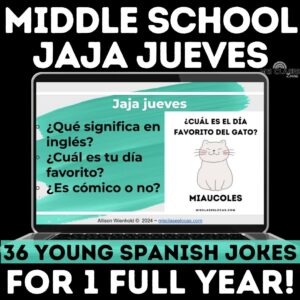
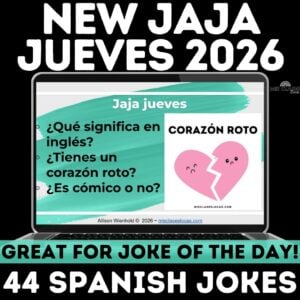
Get Jaja jueves 2026 Spanish Jokes for my newest set of ready to project Spanish jokes!
2. Dad Joke Translation Activity
Students love groaning at a good dad joke in Spanish.
Example:
¿Por qué está triste el libro de matemáticas?
Porque tiene muchos problemas.

Have students:
- read the joke
- guess the meaning
- explain the humor
My Jaja jueves 2026 Spanish Jokes include a variety of dad jokes & other jokes in Spanish.
3. Create Your Own Spanish Joke
Students write their own jokes in Spanish using vocabulary they know.
Prompt ideas:
- animal jokes
- school jokes
- food jokes
- teacher jokes (appropriate ones!)
4. Fake Announcement Prank
Make a silly classroom announcement in Spanish like:
“Hoy tenemos un examen sorpresa de 50 preguntas.”
Pause…
Then reveal:
“¡Es una broma!” It’s just a joke.
*Make sure to not joke about anything sensitive to your students. You also might want to warn any students who have anxiety, or let them be a part of the joke or prank.
Teaching the Word “Joke” in Spanish
Students might ask about Spanish for joke.
Remember there are many regional differences. As your Heritage speakers what vocab they use for Spanish for joke. Common vocabulary includes:
- broma – joke/prank
- chiste – joke
- bromear – to joke
- hacer una broma – to play a prank
- contar chistes / hacer chistes – make jokes
- jaja – haha
These words help students talk about humor and share their own jokes in Spanish.

Simple Jokes in Spanish Students Can Understand
Here are a few Spanish class jokes that work well for novice learners.
¿Qué le dijo un pez a otro pez?
Nada.
¿Qué hace una vaca cuando sale el sol?
Sombra.
¿Qué le dice un techo a otro techo?
Techo de menos.

These examples introduce the concept of a joke in Spanish while reinforcing vocabulary. Plus check out Spanish Rhyming Words for more ideas.
April Fools Day in Spanish class
Adding humor to your lessons is one of the easiest ways to build a positive classroom community. Celebrating April Fools Day in Spanish class allows students to experience language in a fun and memorable way while practicing vocabulary and comprehension.
Whether you start class with a quick dad joke in Spanish, challenge students to write their own jokes in Spanish, or surprise them with a silly announcement, laughter helps make Spanish learning stick.
And if you’re looking for an easy way to bring more humor into your classroom, I’ve created a ready-to-use resource full of classroom-appropriate jokes your students will love.
Key ideas for celebrating April Fools Day in Spanish class:
- April Fools Day in Spanish is not widely celebrated in Spanish-speaking countries.
- The closest cultural equivalent is Día de los Santos Inocentes on December 28.
- Humor can improve engagement and lower student anxiety.
- Simple Spanish class jokes help reinforce vocabulary and comprehension.
- Activities like joke translations and student-created jokes make great lessons.
Want an easy way to add laughter to your Spanish classroom?
My Spanish Joke of the Day resource includes tons of classroom-appropriate jokes in Spanish that are perfect for bell ringers, brain breaks, or even celebrating April Fools Day in Spanish class.
Grab the newest Spanish Joke resource here and start sharing Spanish class jokes with your students today!
Or get a year of jaja jueves for Middle School here.