Inside: Teaching AR verbs in Spanish. Teaching tips and ready to go resources for AR verbs in Spanish.
Author: Alison Wienhold
Published: October 15, 2025
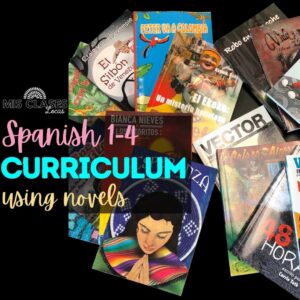
It’s no secret to long time readers, that once I moved to teaching with more comprehensible input strategies, I never looked back. You can see my preferred curriculum below. A mix of communicative resources from a variety of sources put together.
I prefer to teach a new language with the most common verbs such as the Super 7 & Sweet 16 to Spanish learners. Focusing on the most common Spanish verbs in Spanish present tense puts a focus on communication first.
But I know a lot of Spanish teachers are forced or prefer to focus on Spanish grammar. My first two years teaching, I followed Spanish textbooks pretty closely. When teaching Spanish with a textbook, one of the first big grammar concepts students learn are AR verbs in Spanish.
These verbs are the most common type in the language, and mastering them gives students a solid foundation for future verb tenses. Whether you’re a classroom teacher or a homeschool parent teaching Spanish, understanding how to teach regular Spanish AR verbs clearly can make a big difference in your students’ confidence.
What Are AR Verbs in Spanish?
AR verbs are verbs that end in “-ar” in their infinitive form, like hablar (to speak), bailar (to dance), and estudiar (to study). When you remove the “-ar” infinitive ending, you’re left with the verb stem. Then you add the appropriate ending depending on the subject pronoun.
For example conjugating -ar verbs have the following endings.
- Yo hablo – I speak
- Tú hablas – You speak
- Él / Ella habla – He / She speaks
- Nosotros hablamos – We speak
- Vosotros habláis – Y’all speak (Spain)
- Ellos hablan – They speak
This conjugation pattern is the same for all regular Spanish AR verbs, which makes it easier for beginners to practice and remember.
I moved to teaching grammar more in context instead of giving charts in Spanish 1. For example pop up grammar such as just mentioning add -o or yo and o match.
Why Start with AR Verbs?
When students first start learning the Spanish language, it’s helpful to focus on regular AR verbs because they follow a predictable pattern. Learning to conjugate -ar verbs builds confidence and helps students start forming real conversations in the simple present tense.
Once students can comfortably say things like “Yo estudio español” or “Nosotros trabajamos mucho,” they can apply this same process to ER and IR verbs later on.
Common AR Verbs to Teach First
Here are a few of the most common Spanish AR verbs your students can start with:
- Hablar – to talk
- Estudiar – to study
- Trabajar – to work
- Bailar – to dance
- Escuchar – to listen
- Mirar – to watch
- Cantar – to sing
- Caminar – to walk
These common -ar verbs are perfect for practicing because they connect to everyday Spanish vocabulary and allow for example sentences that make sense in class.

Teaching Tips for AR Verbs in Spanish
Here are a few ideas to make your lessons on AR verbs engaging and memorable:
- Start with visuals. Use a conjugation chart so students can clearly see the verb endings for each subject pronoun.
- Use movement. Have students act out verbs like bailar, caminar, or hablar while saying the conjugated form.
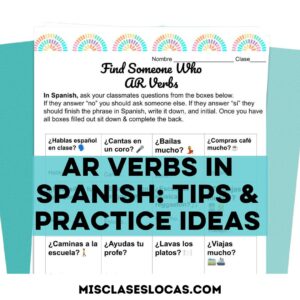
- Practice through games. Try activities like “Find Someone Who” using your Spanish AR Verbs Worksheet, where students walk around and ask each other questions using AR verbs.
- Connect to conversation. Encourage students to use yo, tú, and nosotros forms in short dialogues to simulate daily conversations.
- Include writing practice. Have students write simple sentences with AR verbs in different tenses once they’ve mastered the present tense.
Example Activity to practice AR verb llamar – me llamo, te llamas & se llama
Grab these free name game slides to practice Spansih AR verb llamar in context.
Beyond Regular AR Verbs
After students get comfortable with regular Spanish verbs, you can introduce irregular AR verbs and other verb tenses like the preterite tense and future tense. This helps students see how verb conjugation changes depending on the verb stem or tense.
For example, jugar (to play) is an irregular AR verb because its stem changes (juego, juegas, etc.), so it’s a great next step for more advanced practice.
Conclusion
Teaching AR verbs in Spanish doesn’t have to be boring or confusing. By focusing on patterns, practice, and meaningful use, you can help students quickly build their Spanish speaking and writing skills. Once they’ve got these verbs down, they’ll be ready to tackle new tenses and verb categories with confidence.
Key Takeaways
- AR verbs in Spanish are the most common verb group.
- Start with regular Spanish AR verbs before moving on to irregulars.
- Use movement, visuals, and conversation to make practice engaging.
- The present tense conjugation pattern helps students build a strong foundation.
Get Ready-to-Go Resource
Grab my Spanish AR Verbs Worksheet – Find Someone Who! It’s a fun, low-prep way to get your students speaking, moving, and using AR verbs in real conversations. Perfect for middle school, high school, or homeschool Spanish lessons.
This activity was designed as a communicative activity to get novice Spanish students talking in Spanish. This present tense Spanish ar verbs worksheet review would be great for Spanish 1, Spanish 2, exploratory, or middle school Spanish to talk about activities they do in Spanish. This Spanish speaking and writing activity using Spanish -AR verbs in present tense. Get students speaking and writing in early Spanish 1.
This PDF Spanish AR verbs worksheet contains 6 differentiated versions to fit a variety of class needs. There are 3 speaking & 3 writing options included. Plus not all students in the same class have to have the same 2 speaking & writing versions. Differentiate to support all students. Great options to support IEPs, 504 plans, TAG, ELL & more.
👉 [Get your Spanish AR Verbs Worksheet here!]